
Jun 3, 2019 | The Superyacht Interior Department
Superyacht Crew Hierarchy
Working on a superyacht is truly a wonderful experience, and I can honestly say that I have not worked in such a unique industry before or since leaving the yachting industry. The following article explains the Superyacht Crew Hierarchy in detail along with what a superyacht actually is.
What is a superyacht?
The word yacht comes from the Dutch word ‘jacht’, which means to hunt. Originally the yacht was a light and fast vessel that was used by the Dutch Navy to pursue pirates. After 1650, this developed into a luxury vessel for VIPs and was used by the Dutch Navy until 1843.
Yachts for civilians were known as ‘play yachts’. Until the 1990’s most yachts were usually under 40 metres. Over the years they have slowly become larger. Currently, the largest yacht to date is 163 metres, with a 180 metre ‘new build’ under construction at the world-renowned German shipbuilding company ‘Lurssen’.
Luxury, indulgence, elegant, expensive, bling, sumptuous, rare. The world of luxury yachting has taken off exponentially in the new Millennium. It seems the rich and famous are no longer satisfied with a mere luxury superyacht, and towards the end of the last century, the term ‘mega and ‘Giga’ yacht had come into use.
This has resulted in an increase in the demand for highly skilled crew. The years of backpacker dominated docks have been replaced by the bachelor holding hotel managers and commercially qualified professional seamen.
There is no absolute definition of this subject, so this is what I found on Wikipedia:
“The term luxury yacht, superyacht, large yacht and mega yacht, refers to the expensive privately owned yachts, which are professionally crewed.”
Who owns these superyachts?
Well, it’s no surprise that superyachts are owned by wealthy people. The superyacht industry knows no boundaries and the yacht owners come from all corners of the globe. The yacht owners are people from varying backgrounds. It is true that some owners are movie stars and celebrities.
The majority of the owners are wealthy business people, who prefer to stay away from the paparazzi and who prefer to have their identity kept secret. The yachts are used for various reasons.
Some are completely privately owned, others are for charter only, and the rest operate between these two positions. Charter prices also range from tens of thousands, through to hundreds of thousands.
The Organisational Structure
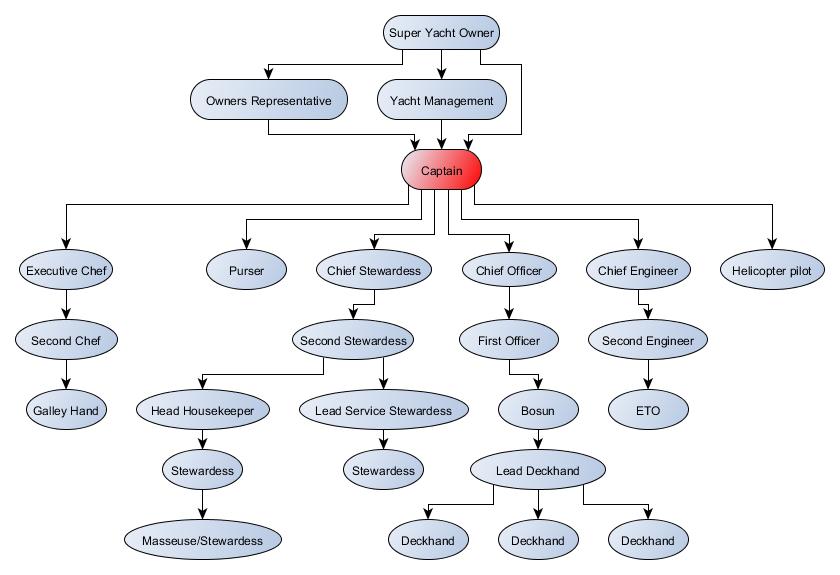
The organisational structure onboard a superyacht can best be described as being top-down and strongly hierarchical (as shown below) based upon a military model. Where positions, job duties and lines of authority are set, however, a superyacht is not the military, nor is it merchant shipping or large-scale commercial shipping like cruise liners.
Obviously, the larger yachts will have more crew with the same title and job description. Another area that may cause a little confusion is in the galley. Most yachts run with a chef or cook on a smaller yacht and only the larger super/mega yachts run with a team of chefs.
The following diagram represents clearly the formal structure by which superyachts operate. It also shows a clear separation of authority and duties of their hierarchical rank.
A Superyacht runs this way for a few reasons:
- An authoritative chain of command is implemented for safety reasons, with the Captain is the master of the vessel… the king of the castle so to speak, with the Chief Engineer and Chief Officer following closely behind with the safety of the crew and vessel in their hands.
- The middle managers follow in line to execute the commanding orders.
- Followed by the lower ranks to carry out the orders.
This diagram broadly represents the chain of command on board a superyacht (please keep in mind that this example is a general summary and yachts will differ in the organizational structure.).
The horizontal specialization of the crew is again quite obvious, with each department specializing in their relevant departments:
Superyacht Crew Hierarchy
-
Engineering: Safety and smooth operational running of the vessel and hotel services.
-
Deck: Passage delivery, Safety, Outside housekeeping/maintenance, guest outdoor activities.
-
Interior: Guest wellbeing, guest control in an emergency, housekeeping, hotel management, activity planner, accounting and guest liaison.
-
Galley: Guest food preparation, crew food preparation, galley and store stock control, hygiene and maintenance.

Mar 6, 2015 | The Chief Stewardess, The Superyacht Interior Department
The Order of Service
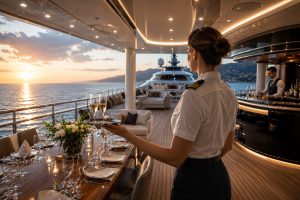
Mastering the order of table service is one of the cornerstone skills of a professional superyacht stewardess. Service at sea is held to the standard of the world’s finest restaurants — and on a yacht, where the dining room may seat the owner, their family, and their most important guests just a few feet away, there is no margin for hesitation or error.
Knowing the correct order of service matters for several reasons: it ensures guests are served in the proper sequence according to etiquette, it keeps the flow of service smooth and unobtrusive, and it communicates a level of professionalism that ultra-high-net-worth guests expect as a baseline. Below are the guidelines to help you master the art of fine dining service on board.
A Note on Cultural Awareness
Before we begin, an important point: the precise order of service can vary from culture to culture, and a skilled stewardess always takes the time to understand the cultural norms and preferences of the guests she is serving. What is correct in one tradition may differ in another.
For the purpose of this guide, I will use English formal dining etiquette as the example — but treat it as a foundation to adapt from, not a rigid rule to apply blindly.
The principle behind all of this is simply hospitality at its highest level. As the Auguste Escoffier School of Culinary Arts puts it, this style of service represents the highest level of hospitality — one that elevates the guest experience and makes a meal genuinely memorable. That is precisely what you are aiming to deliver on every charter, every evening, every service. Escoffier
The Order of Service
 Begin with the guest of honour. Traditionally, service begins with the lady of honour — normally seated to the right of the host — and proceeds anticlockwise around the table, ending with the host. If you are unsure who the guest of honour is, a useful clue on board is to note who is occupying the VIP cabin.
When the setting is less formal, serve ladies first. If the guest of honour is not obvious, or if the atmosphere on board is more relaxed, the reliable general rule is to serve all the female guests first, followed by all the male guests, ending with the host. This convention is echoed in formal restaurant training, where it is common practice to begin with the ladies before completing a second lap of the table for the gentlemen.
Always serve in one direction. If you are ever uncertain about precedence or who should be served next, the single most important principle is this: move in one consistent direction around the table. Never go back and forth. Doing so wastes time, disrupts the rhythm of service, and looks unmistakably unprofessional.
Work as a coordinated team. Depending on the vessel’s resources, there will usually be two or more stewardesses on service at any one time. The flow between you should be seamless and rehearsed, so that the table is served smoothly and efficiently, almost invisibly.
Plates: serve and clear from the left. Food plates are always served and cleared from the guest’s left-hand side.
Clear together — with one exception. Plates are normally cleared all at once, after the host has finished eating. This is a long-standing convention of formal service. As the team at Escoffier note, you should traditionally wait for all guests to finish the course before clearing — removing one guest’s plate while others are still eating can make those remaining feel rushed or self-conscious. The exception is dessert, where individual plates may be cleared as each guest finishes. Escoffier
Beverages: serve and clear from the right. All drinks are served and cleared from the guest’s right-hand side.
Glassware and wine changes. If the same wine is being served across consecutive courses, the same glass may be used. However, when the wine changes with the course, a fresh, clean glass must be placed for the new wine. Handle glassware by the stem to avoid fingerprints, and ensure every glass is spotless before it reaches the table.
Bringing It All Together
The order of service is not about rigid formality for its own sake. It is about creating an experience so smooth and considered that the guests never have to think about it at all — they simply enjoy their meal, their wine, and their evening, while the service happens around them with quiet precision.
Learn the sequence until it becomes instinct. Adapt it intelligently to your guests and your vessel. And remember that the very best service is the kind that is felt rather than noticed.
Adapted from The Stewardess Bible’s Guide to Achieving Excellence in Service.

