
Sep 12, 2019 | Housekeeping
Small Space – Storage Solutions
As a superyacht stewardess, you are required to be very creative with your small space storage solutions. The storage area needs to be clean, dry and easily accessible…. Which, let’s face it, is quite often NOT the case…..
If you are like me and had your fair share of battling with mattresses to get to the under bed storage or contorting your body into the most fabulous position to get into a tiny bilge space, then I think the following article will be quite helpful.
Generally, on superyachts, we do not have the luxury of walk-in storage areas unless you are on an 80m+ vessel and even then you may find yourself in a storage battle with other departments staking claim over the precious space…
So before your frustration levels skyrocket let’s look at what you have to work with:
You may find storage in the following areas:
- Obvious cupboards in the crew area and guest accommodation
- Under bed storage: Both in the guest and crew accommodations
- Bilge areas
- Under furniture in both the guest and crew areas
- Outside under furniture
- Under the bridge consul
Important:
Now before you start to distribute your interior stuff everywhere… it is very important to respectfully ask each department to allocate space for you.
Storage items:
On a yacht, there seem to be a million things to store and so little space to store it in. So I have selected just a few items that seem to always be in the “more challenging items to store” category.
- Space bags for things you won’t need on charter
- Blue tape around types of clothing (ordered by item, not size)
- Blue tape around sizes of items
- Ziplock bags of clothing items
- Ziplock bags of items by size
- Plastic containers if space allowed
Unless you are lucky enough to have an allocated large cupboard for this I would normally store this under a bed. As with many things on this board it is really a personal preference. However, experience suggests that ordering the items by size and type is an effective solution. You can always see what the item is but finding the right size can be time-consuming.
You will be limited to what and where you can store things in the guest accommodation, however, in the crew cabins you can think in various dimensions. For example, look at vertical dividers in cupboards or hanging shoe bags on the back of doors.
Toilet paper and kitchen towels:
- Toilet paper and kitchen roll stored in bilges
- Stored in hanging nets in walking laundry cupboard
For bulkier items such as toilet paper and kitchen towel, before a charter or cruise, make sure that all of the internal cupboards are stocked well (this included under the bathroom sinks in crew cabins).
Next, make sure the galley pantries and crew mess are well stocked and then place the kitchen roll on top of the toilet paper.
Just make sure that the storage area is clean and well ventilated.
Drinks, water bottles, cans:
AUUGHGGH, drinks storage can be a royal pain in the A#$%, but with a little planning, it really shouldn’t be so hard. What I mean by this is start off by doing a little math…
Step one:
- See how much space you have. This may be 2 forward lockers, lockers on the sundeck and locker on the aft deck etc.
Step two:
- Use the space wisely.
- For the larger lockers buy plastic crates with holes in them for ventilation and an escape route if any water gets in them.
- Calculate how many bottles of water fit into space. Use this as a guide for provisioning. I.e. if you know the forward locker fits 50 x 2L bottles of water then you can easily estimate what you need for your next order.
- A good tip here is to buy a combination of both foldable crates and permanent size crates, both have a useful purpose on board.
Step three:
Go ahead and calculate all of your storage areas. If you do this properly then it will make your life so much easier in the future with mid-season provision requirements.
Wine and liquor:
So by now, you have probably figured out that storing wine on a yacht can be very challenging. The usual recommendations of wine storage such as:
- Temperature
- Humidity level
- Motion Restriction
Are pretty impossible to control on a yacht. In addition to this, you will also have to find suitable storage, which enables easy access yet it has to be secure enough that the bottles won’t break.
Typically the wine tends to be consumed on the cruise/charter, however, if it is not then common sense dictates that fine wine be stored on land for longer storage requirements.
Once the wine fridges, bar, pantries and allocated cupboards are stocked to capacity, you will need to look to the under furniture storage. If possible, I would recommend storing any excess wine amidship like in the main saloon or lower deck in the VIP cabin purely due to the lesser motion of the vessel.
There are many things that you can use to protect the bottles such as:
- Bubble plastic
- Towels
- Even kitchen roll
However, the one product that I highly recommend is a protective mesh wine sleeve.
- I love this product because it’s cheap, easy to get and easy to store any excess.
- It saves the glass bottles from smashing or clinking together and it protects the very important label.
- Finally, because its mesh you can easily see what you need
- You can buy it online from Amazon, or you can try your local ship chandlery
Remember: all cardboard should be removed from the yacht to illuminate the risk of cockroaches or other nasty bugs becoming your new nightmare on board.
Further reading on wine storage:
https://www.onboardonline.com/industry-article-index/provisioning-and-galley/a-stellar-cellar-on-board/
If there something that you would like help with then please leave a comment below or email admin@stewardessbible.com

Aug 1, 2019 | Wine
Wine Basics for The Superyacht Stewardess. This is one of those subjects that is very involved and requires a lot of training to master. In fact, it takes years to become a master sommelier.
As a superyacht stewardess, you do not need to go to such lengths, however, you are required to have a good foundation on this topic. Furthermore, learning the basics of wine cannot only help you select the best wines for your guests to enjoy, but it will also help you improve your taste preferences.
With many types of wines to purchase and serve, it can become quite confusing to understand the best wines to choose and how to read a wine label properly. The following article just scratches the surface of this vast subject.
Please comment below if you would like to see more content like this.
How is Wine Made
Wine-making begins with grapes on the vine. Grapes must be properly ripe before they are picked for wine. Overly-ripe grapes or grapes that are not ripe enough will cause the taste of the wine to suffer.
The quality of the grapes is essential for the best-tasting wine because they are the foundation for the beverage.
- Grapes can be hand-picked off the vine or machine harvested
- Once the grapes arrive at the winery, the grapes are sorted through
- Any rotten grapes are removed
- Stems are then removed from the grapes, and then the grapes are crushed slightly.
White and red wines differ in how they are made. White wines are pressed, which separates the juice from the skins. The process is performed before the grapes are fermented.
Red wines get fermented in their skins. During the fermentation period, grapes are hand mixed to extract the juices and to prevent bacteria from growing. After the grapes have finished fermenting, the red wines are moved to barrels where they will complete maturation.

Wine Grape Variations
There are numerous types of grapes that can be used to make wine. The different varieties of grapes used will alter the flavour of the wine. The thousands of grape varieties make it possible to experiment with flavours to create a wide range of wines with distinct flavours.
It’s important to understand the characteristics of many of the popular grapes used to wine to get a better idea of how they will affect the overall taste of the wine. Learning about what types of grapes yield the best white or red wine is crucial when it comes to wine-making.
Popular White Wine Grapes
- Chardonnay is a classic variety of grape used to create white Burgundies. It’s one of the most popular types of grapes used to make Champagne.
- Muscadine is another white wine grape variety, and it’s grown primarily in the southeastern United States and Mexico. It produces grapey-tasting flavour and is commonly known for its use in the Tokay.
- Chenin Blanc is another popular white wine grape variety. It features good acid levels, thin skin, and natural sugar content that is high. It’s used in Pinot Chardonnay, Pinot Blanc, and Muscadet wines.
- Malvasia is a grape variety that produces wines that can have numerous tastes. Wines made from these grapes can have sweet flavours to flavours that are exceptionally dry.
Popular Red Wine Grapes
- Merlot is a grape variety that ripens early. It produces red wines that feature flavours of cherry, toffee, and plum. Nebbiolo is another popular red wine grape variety and is a grape that ripens late. It features prune, chocolaty, and tannic characteristics.
- The Nebbiolo grape variety is known to be difficult to grow.
- Pinot Noir is an important grape variety used to make Burgundy wine. Wines made from these grapes feature strawberry, raspberry, and cherry aromas.
- Gamay is the only red grape featured in Beaujolais wines. Flavours of wine made from this grape variety have been described as bubble gum and banana flavoured that eventually evolve into walnut, hazelnuts, and spice.
Bottle Variations
Bottle variations are a term used in wine to describe bottles of the same wine that feature different smells and tastes. The factors that could affect the taste and smell of the wine include the variation of the contents prior to packaging and any variation used in storage and distribution.
It could also have an impact on bottle variations in any differences in the packaging components and the product and packaging process. One of the most prominent factors that have an influence on wine bottle variation is the variable levels of oxygen exposure.
How Many Glasses of Wine are in a Bottle
When you buy a bottle of wine, it’s important to know how many glasses of wine you’ll be able to pour from one bottle. The size of the wine glass used determines the number of services you’ll get out of the bottle.
Most bottles of wine contain 25.4 fluid ounces. If you pour four-ounce servings of wine, you’ll get six servings per bottle of wine. If you pour five-ounce servings, you’ll get five servings of wine.

The General Basics of Reading a Wine Label
Reading a wine label can be quite confusing. There’s a lot of information to take in before you can make a purchase. Learning how to read a wine label properly is important.
A wine label will feature:
- The producer of the wine
- Vintage or non-vintage
- Region
- Variety and ABV.
Note: The variety of appellation refers to the grape varieties used in the wine-making process. Vintage or non-vintage is the year the grapes were harvested. ABV stands for alcohol by volume.
Wine Basics – For The Superyacht Stewardess. For more like this buy your copy of The Stewardess Bible today

Jun 3, 2019 | The Superyacht Interior Department
Superyacht Crew Hierarchy
Working on a superyacht is truly a wonderful experience, and I can honestly say that I have not worked in such a unique industry before or since leaving the yachting industry. The following article explains the Superyacht Crew Hierarchy in detail along with what a superyacht actually is.
What is a superyacht?
The word yacht comes from the Dutch word ‘jacht’, which means to hunt. Originally the yacht was a light and fast vessel that was used by the Dutch Navy to pursue pirates. After 1650, this developed into a luxury vessel for VIPs and was used by the Dutch Navy until 1843.
Yachts for civilians were known as ‘play yachts’. Until the 1990’s most yachts were usually under 40 metres. Over the years they have slowly become larger. Currently, the largest yacht to date is 163 metres, with a 180 metre ‘new build’ under construction at the world-renowned German shipbuilding company ‘Lurssen’.
Luxury, indulgence, elegant, expensive, bling, sumptuous, rare. The world of luxury yachting has taken off exponentially in the new Millennium. It seems the rich and famous are no longer satisfied with a mere luxury superyacht, and towards the end of the last century, the term ‘mega and ‘Giga’ yacht had come into use.
This has resulted in an increase in the demand for highly skilled crew. The years of backpacker dominated docks have been replaced by the bachelor holding hotel managers and commercially qualified professional seamen.
There is no absolute definition of this subject, so this is what I found on Wikipedia:
“The term luxury yacht, superyacht, large yacht and mega yacht, refers to the expensive privately owned yachts, which are professionally crewed.”
Who owns these superyachts?
Well, it’s no surprise that superyachts are owned by wealthy people. The superyacht industry knows no boundaries and the yacht owners come from all corners of the globe. The yacht owners are people from varying backgrounds. It is true that some owners are movie stars and celebrities.
The majority of the owners are wealthy business people, who prefer to stay away from the paparazzi and who prefer to have their identity kept secret. The yachts are used for various reasons.
Some are completely privately owned, others are for charter only, and the rest operate between these two positions. Charter prices also range from tens of thousands, through to hundreds of thousands.
The Organisational Structure
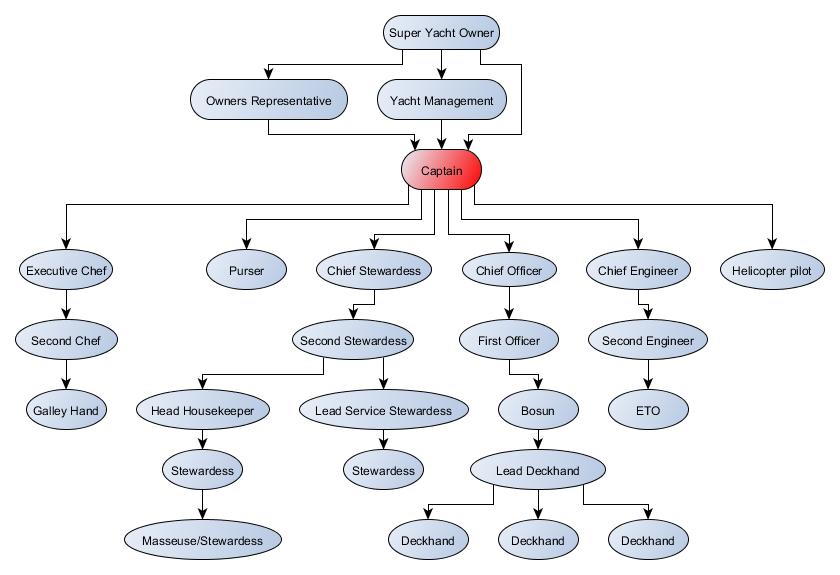
The organisational structure onboard a superyacht can best be described as being top-down and strongly hierarchical (as shown below) based upon a military model. Where positions, job duties and lines of authority are set, however, a superyacht is not the military, nor is it merchant shipping or large-scale commercial shipping like cruise liners.
Obviously, the larger yachts will have more crew with the same title and job description. Another area that may cause a little confusion is in the galley. Most yachts run with a chef or cook on a smaller yacht and only the larger super/mega yachts run with a team of chefs.
The following diagram represents clearly the formal structure by which superyachts operate. It also shows a clear separation of authority and duties of their hierarchical rank.
A Superyacht runs this way for a few reasons:
- An authoritative chain of command is implemented for safety reasons, with the Captain is the master of the vessel… the king of the castle so to speak, with the Chief Engineer and Chief Officer following closely behind with the safety of the crew and vessel in their hands.
- The middle managers follow in line to execute the commanding orders.
- Followed by the lower ranks to carry out the orders.
This diagram broadly represents the chain of command on board a superyacht (please keep in mind that this example is a general summary and yachts will differ in the organizational structure.).
The horizontal specialization of the crew is again quite obvious, with each department specializing in their relevant departments:
Superyacht Crew Hierarchy
-
Engineering: Safety and smooth operational running of the vessel and hotel services.
-
Deck: Passage delivery, Safety, Outside housekeeping/maintenance, guest outdoor activities.
-
Interior: Guest wellbeing, guest control in an emergency, housekeeping, hotel management, activity planner, accounting and guest liaison.
-
Galley: Guest food preparation, crew food preparation, galley and store stock control, hygiene and maintenance.

May 9, 2019 | Housekeeping, The Superyacht
HOW TO REDUCE PLASTIC USE
As superyacht stewardesses, we see the damage caused to our oceans and waterways by plastic daily. Moreover, its no surprise to know that plastic pollution is a global problem that threatens aquatic life.
Therefore, it is necessary for everyone to take small steps to reduce plastic use as well as take good care of their environment.
This article is written for the superyacht stewardess but can be applied to all walks of life. Further, it aims to highlight some steps to follow to reduce plastic use and pollution.
Cutting down the Daily use of Plastic
Avoid using plastic straws.
These straws are a massive problem in ocean contamination; they are also among the most picked up trash on beaches.
To stop straw use is straightforward: As a consumer, simply do not order a straw, and as a superyacht stewardess do not offer a plastic straw. If you guests asks for one, offer a bamboo straw instead.
Make use of a reusable tumbler or a no-go mug when you order coffee. As a consumer, take your own insulated coffee cup along to your favourite coffee shop. The use of insulated tumblers will also keep your beverages hot or cold a lot much longer.
Moreover, You also need to know that paper coffee cups are mostly coated with plastic resin, so you need you to avoid these as well and go for reusable containers.
Avoid dry-cleaning in reusable bags.
Avoid making use of the dry-cleaners’ one-time-use plastic bags and nasty coat hangers. Instead, provide your dry cleaner with your own coat hangers and reusable bags.
Avoid chewing gum.
How would have thought that chewing gum was so bad for the environment! However, according to Planet experts, it is.
The gum was initially made from natural materials like sap and rubber, but manufacturers now make use of a type of synthetic plastic instead.
Therefore instead of mindlessly grabbing the first of chewing gum, you see look for a biodegradable natural gum or eat mints instead.
As a superyacht chief stewardess who does all of the provisioning’s onboard, this is one area that you have complete control over and one tip that can be extended throughout all of your product purchases

Check out these romantic biodegradable straws
Make use of eco- friendly shopping tips
Use reusable bags to carry your groceries.
Yearly, billions of plastic bags occupy landfills. In order to help reduce this number, use your tote bags when you go grocery shopping.
- Reusable bags are much sturdier for moving groceries and will make a large impact on the number of plastic bags used.
- It is easy to get reusable bags at most grocery stores and if you are using a provisioning company, ask them not to use single-use plastic bags.
- Buy food from bulk bins and store them in reusable containers. Purchasing foods from the bulk section will save you money as well as lots of plastic packaging.
- So instead of bagging your bulk foods up in plastic bags make use of your reusable bags or containers.
- Waste-free storage options include cotton bags, glass jars and stainless-steel containers.
- You may consult the customer service desk if you are worried about how your containers will affect the weighing and paying.
- This is because most stores have weighing options for personal containers. Cotton bags have their weight printed on the bottom which makes the weighing process easier.
Avoid purchasing bottled beverages.
Stop your use of plastic bottles by getting alternatives, i.e. by using a reusable bottle to fill up with water, by making your own soda with machine-like Soda Stream, or you purchase fresh fruit to make your juice.
I acknowledge this is a hard thing to do onboard a superyacht, but as we are all citizens of this planet, this point is for everyone, so please just do your best.
Purchase secondhand toys and electronics.
This is because new toys and electronics come with excess plastic packaging. This may not be an easy tip to adopt onboard the superyacht if you are shopping for the guests, but it is easily done in your private life.
Shopping secondhand helps you eliminate waste and high price.
Reduce Plastic onboard the Yacht.
Keep your food in glass containers or jars.
This is a super easy thing to change onboard. And if you are worried about breakage, then there are other alternatives, such as wheatgrass containers, or upcycled plastics. Also, check out the beeswax food wraps.
Produce your own multi-purpose cleaner.
The vinegar and water cleaning solution for example.This help to prevent the purchase of cleaners in plastic bottles.
Try recycling your plastic products. After you might have used all plastic products make sure to recycle instead of disposing of them.
You should have a recycling service stop by and have the plastic products picked up at your home, or you take plastics to the facilities.
I have written an article on this matter for Dockwalk magazine, which you can check out here:
- The Superyacht Stewardess and Going Green
CONCLUSION
Reducing plastic use involves everyone taking small steps which all amount to a solid solution.
These steps as listed above include replacing single-use plastics with reusable options, when shopping, shop secondhand and purchase in bulk to reduce plastic packaging.
Each step seems small, but small steps will add up to significant change!
Lastly, I encourage everyone to do there homework on this issue. The following websites are a great help:

Nov 5, 2018 | Flower Care
How to Care for Orchids Aboard a Superyacht
The orchid is one of the most beautiful flowers you will encounter in the superyacht interior — and one of the most misunderstood. Many stewardesses approach them with a degree of apprehension, assuming they are fragile, temperamental, and altogether too delicate for life at sea. In my experience, this simply is not the case. Orchids are remarkably resilient plants that ask for very little — provided you understand what they actually need, which is considerably less than most people give them.
Once you do understand them, you will wonder why you were ever nervous.
What Is an Orchid, Exactly?
Before we get into care, it helps to understand what kind of plant you are working with. Orchids are epiphytes — what is sometimes called an “air plant.” In the wild, they do not grow in soil. Instead, they attach themselves to tree bark and roots, drawing their nutrients from organic matter that collects around their root systems, and drying out naturally between periods of rainfall.
This is the single most important thing to understand about orchid care: these plants are not designed to sit in wet soil. Roots that remain permanently damp cannot absorb oxygen, and they rot. The vast majority of orchid deaths aboard yachts — and in homes and hotels — come down to overwatering. Keep that at the front of your mind and you are already ahead.
The Four Things an Orchid Needs
Orchids are tropical plants. They require four conditions to thrive:
- Indirect light — bright but never direct sunlight
- Consistent, measured watering — far less than instinct suggests
- Warm, stable temperatures — between 22 and 25°C during the day, never below 15°C
- Occasional feeding — a diluted orchid fertiliser applied monthly is sufficient
Provide these four things reliably, and your orchids will bloom continuously for weeks.
Watering: Less Is Always More
The most effective watering method for orchids on board is to place two to four ice cubes directly onto the growing medium — the bark or moss surrounding the roots — once a week. As the ice melts slowly, it releases moisture at a gentle, controlled rate that avoids sudden saturation and root shock.
A word of caution: always position the ice cubes around the roots, never on the crown of the plant. The crown is the central growing point from which the leaves emerge. If meltwater pools there, it can cause the leaves to rot over time — a common mistake that is entirely avoidable.
If you are unsure whether your orchid needs water, press two fingers gently into the growing medium and withdraw them. If they come out dry, it is time to water. If there is any residual moisture at all, wait another day or two. When in doubt, do not water.
Temperature and Light
Orchids need warmth and consistency. The ideal daytime temperature is between 22 and 25 degrees Celsius; they should never be exposed to temperatures below 15°C. On a well-managed superyacht, climate control generally provides the right conditions — with one important caveat.
Air conditioning dries out the growing medium more quickly than you might expect. If your orchids are positioned in a heavily air-conditioned space, check moisture levels more frequently than you would otherwise. Do not place orchids directly in the path of an air conditioning vent — the cold, dry air is damaging to both the roots and the foliage.
For light, position your orchids near a window or porthole for natural brightness, but set them back from direct sunlight. Direct sun will scorch the leaves and bleach the blooms. The ambient ceiling lighting on most superyachts is not sufficient on its own — a position that captures natural daylight, filtered through glass, is ideal.
Humidity and Airflow
Orchids love humidity, which makes the sea air a naturally hospitable environment. However, high humidity combined with poor air circulation is a recipe for fungal problems and rot. The goal is moderate humidity with gentle, consistent airflow — away from vents, but not tucked into a stagnant corner.
Guest bathrooms and ensuite heads can actually be excellent environments for orchids, provided the ventilation is adequate. The natural humidity from the shower, combined with good airflow, often suits them beautifully.
Leaf Care
Over time, the broad, waxy leaves of an orchid will gather dust. This dulls their appearance and reduces the plant’s ability to absorb light — neither of which you want on a vessel where presentation is everything.
To clean the leaves, dip a piece of cotton wool in whole milk and wipe each leaf gently. The milk clears surface dust, nourishes the leaf, and leaves a beautiful, natural gloss. It is a simple trick, but the results are genuinely impressive.
Never spray orchid flowers directly with water. Moisture on the petals causes browning, and a brown orchid petal is not something you want near a guest’s dining table.
Common Mistakes to Avoid
- Overwatering — the single most common cause of orchid death. Always err on the side of too little.
- Placing ice on the crown — position it around the roots only, never in the centre of the plant.
- Direct sunlight — use indirect, filtered natural light.
- Air conditioning vents — the dry, cold air damages roots and foliage alike.
- Allowing the plant to touch walls or other surfaces — contact causes bruising on the delicate leaves and petals.
- Planting in regular potting soil — orchids must be grown in bark or orchid-specific medium to allow adequate drainage and root oxygenation.
A Note on Growing Medium
Orchid bark is the preferred medium for most superyacht applications. It drains freely, allows the roots to breathe, and is available in most provisioning ports. If your orchids arrive potted in moss — which is perfectly acceptable — be aware that moss retains moisture significantly more readily than bark, making overwatering an even greater risk. Allow the moss to dry out fully before rewetting it, and if you are ever unsure, switch to bark.
Final Word
A beautifully tended orchid is one of the simplest and most effective ways to elevate the interior aesthetic of any superyacht. Once you understand that these plants reward restraint rather than attention — less water, indirect light, stable warmth, and the occasional leaf polish — they become one of the most satisfying plants to keep at sea.
Care for your orchids the way you care for your guests: attentively, but never intrusively. Give them what they need and then trust them to do the rest.
Good luck — and enjoy the blooms.


