May 30, 2026 | The Superyacht Stewardess
Exploring a Career as a Superyacht Stewardess
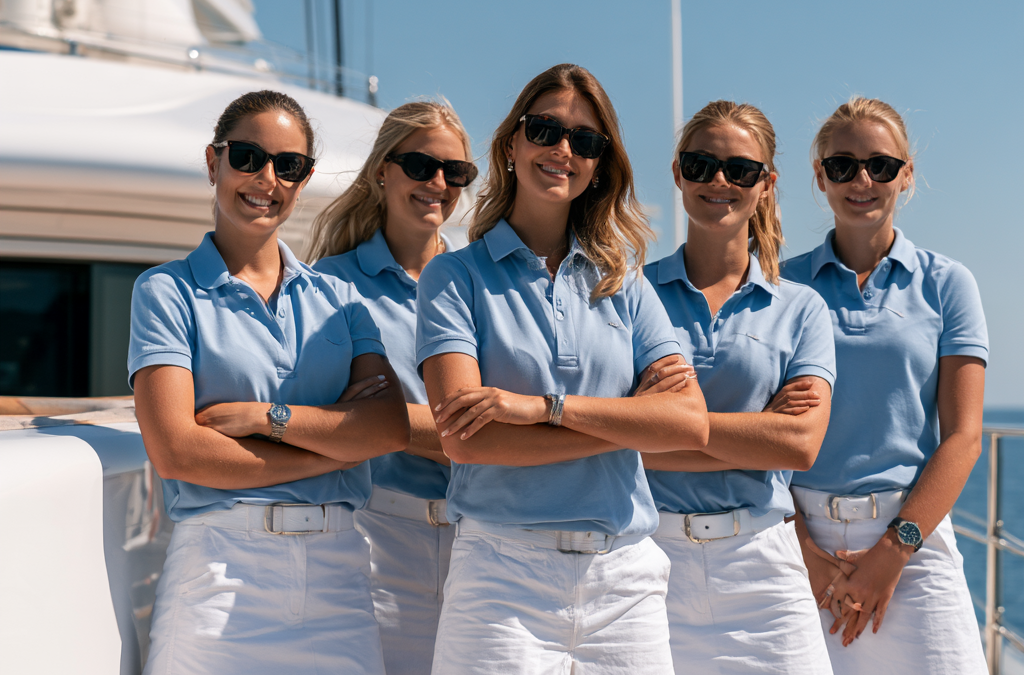
So you’re thinking about becoming a superyacht stewardess. Good. It’s one of the most rewarding careers I know of, and one of the most misunderstood. Most people picture someone in a smart uniform pouring drinks on the aft deck. The reality is far bigger than that, and far more interesting. This is an honest look at what the role actually involves and what it takes to do it well.
You’ll Wear a Great Many Hats
A superyacht stewardess is not a hostess. She is a versatile professional who moves between a dozen different responsibilities in the course of a single day, often within the same hour. One moment you’re detailing a guest cabin to a standard most hotels never reach, the next you’re laying a table for a formal dinner, then arranging flowers, then stepping into a safety role during a drill.
The work spans hotel-standard housekeeping across every cabin, lounge and common area; food and beverage service of the highest order; safety and emergency duties, because every crew member is part of the vessel’s safety team; guest relations and butler-style anticipation of needs before they’re spoken; and the quieter behind-the-scenes operations like laundry, personal shopping and the relentless time management that holds it all together. There’s a creative side too: floral arrangements and hosting touches that lift the whole atmosphere of the vessel.
If you take one thing from this, take this: the job is dynamic, demanding and varied. Serving tea and coffee is the smallest part of it.
Excellence in Beverage Service
On a superyacht, the drinks are part of the experience, and the standard is high. You’ll need real knowledge, not just a willingness to pour.
That means understanding wine properly — how it’s stored, how it’s served, and which bottle suits which dish. It means handling champagne, port and cognac with confidence. It means crafting and serving everything from a well-kept beer to an inventive cocktail. And it means looking after the non-alcoholic side just as carefully: fine teas, good coffee, and, on some vessels, quality tobacco service when it’s called for. A guest who orders a simple sparkling water should feel as well looked after as one ordering a vintage they’ve flown in specially.
Mastering the Styles of Food Service
You’ll need to be comfortable across several dining service styles, because different occasions and different owners call for different approaches.
Silver service, where food is offered from platters for an elegant presentation. Plate, or American, service, where dishes come plated straight from the galley. English and Russian service, for communal or individual presentation depending on the setting. And buffet service, which sounds simple but takes real precision to run beautifully. On top of the techniques, you’ll work closely with the head chef and chief stewardess on table management, because a flawless meal is always a team effort.
Keeping It Spotless
Superyacht interiors are extraordinary, and keeping them that way is one of the core demands of the role. Guest cabins must be immaculate and genuinely comfortable. Public areas — the lounges, the dining spaces — must stay spotless throughout the day. And the crew quarters matter too, even though guests never see them, because standards don’t drop just because no one’s watching.
Laundry and Fabric Care
This is a skill in its own right, and an underrated one. You’ll be caring for delicate and expensive fabrics — cotton, silk, wool, leather — each with its own rules. Get it wrong and you’ve ruined something irreplaceable. Under the chief stewardess’s guidance, protecting the condition of high-end textiles becomes a daily discipline.
Floral Arrangements and Plant Care
Fresh flowers and well-tended plants change the feel of a space completely, and out at sea you rarely have a professional florist to call on. The ability to put together an elegant arrangement yourself is a genuinely valuable asset, and one that owners and guests notice.
Personal Presentation and Grooming
Appearance counts for a great deal in this industry. A polished, well-groomed look, a uniform worn properly, and a clear sense of personal presentation all feed into the impression you make. It isn’t vanity. It’s part of how you build the trust and confidence of the guests you look after.
Etiquette and Communication
How you carry yourself and how you speak matter just as much as what you do. Knowing how to read and respond to guests, both in what you say and in how you behave around them, means every interaction is handled with grace, respect and cultural awareness. On a vessel hosting people from all over the world, that sensitivity is essential.
Safety Comes First
Beneath the polish, a stewardess carries real safety responsibilities. You’ll work to standards like STCW and the vessel’s own onboard protocols, and your readiness to handle an emergency is every bit as important as your service skills. The glamour is real, but it sits on a foundation of proper training and genuine preparedness.
Training for Success
To do this job well, you need to train for it properly. The STCW certification is the mandatory starting point, but the stewardesses who really excel go further, with specialist courses in service that prepare them for the particular demands of luxury yachting. Good training sharpens your skills and opens doors to better positions.
A career as a superyacht stewardess means mastering a wide range of skills, from food and beverage service to housekeeping, safety and far beyond. With the right training and real dedication, it’s a genuinely rewarding path, and one that can take you around the world.
So that’s what a superyacht stewardess actually does. For the complete reference manual covering every part of the role, visit the bookstore.

Apr 8, 2016 | The Superyacht Stewardess
Mindfulness & The Superyacht Stewardess
The Superyacht industry is truly a unique place to work, and as such, you can easily get swept up in the drama that can be associated with living in a bubble.
Mindfulness seems to be the ‘buzz’ word of this generation. His Holiness the Dali Lama lives by it, Deepak Chopra teaches it and the Harvard Medical School students are writing research reports about it.
So why is mindfulness receiving so much attention these days, especially since the world is getting busier and busier.
- We make a plan for the weekend whilst watching TV and playing with the dog
- We fold the washing whilst watching the kids,
- We eat our lunch whilst sat at our desk for 8 hours without a break
- We drive our cars around on autopilot
- We “do, do, do, do, do, do,” all day long without engaging our brains into the one single activity that we are actually doing at the time.
The superyacht stewardess does all of the above, just in a different way. Her day is just as busy as the regular woman at home.
This article will explain what mindfulness is, how it comes to be and how we can master mindfulness in with our busy daily schedules.
What is Mindfulness?:
“Mindfulness is the practice of purposely focusing your attention on the present moment and accepting it without judgement” (Siegel 2009, Harvard Health Publications).
The History of Mindfulness:
The art of mindfulness has been around for generations with strong roots being founded in Buddhism. However, every religion, prayer group and meditation practices, teach us to be aware of the present moment and leave the preoccupying thoughts behind.
For those readers who are not religious at all then you will be pleased to know that science is now taking an interest in mindfulness as it helps to reduce the effects of stress on our bodies and minds, which results in a happier more positive outlook on life.
Mindfulness also decreases psychological symptoms, such as:
- Depression
- Anxiety
- Sleep and mood disorders.
Mastering the Art of Mindfulness:
Mindfulness is being aware at the present moment. It is being aware of your body, mind and spirit; it is paying attention to words, tasks, feelings, and atmosphere.
Mindfulness is not some new age “mumbo jumbo” nonsense created by hippies and social outcasts to shame the rest of us for living extravagant lives.
It is a way of thinking and a way of being that EVERYONE has instant access to regardless of your personal beliefs or religious followings.
We can cultivate and nurture mindfulness through various mediums, such as:
Basic mediation and mindfulness.
Sit quietly and focus on your breathing, let the thoughts come in and out, do not judge these thoughts or put any pressure on yourself at this time. Practice a mantra out loud or quietly to yourself.
The idea here is to systematically focus your attention on what you are doing and how you are feeling.
- Body sensations: Notice any subtle or strong sensations in your body, notice they don’t think about them or judge them, now let them pass.
- Sensory: Notice, smells, sounds, sights, colours, tones, taste and touch, do not judge them and let them pass.
- Emotions and urge surging: Coping with cravings can be challenging for us all; so the idea here is to notice how your body is responding to the urge. Replace the physical urge with knowledge, that in time it will pass. You are aware that nothing ever stays the same and life is a continual river of change. You have the power within you to resist the urge.
By practising mindfulness techniques, daily you will slowly be empowered to take your life into your own hands without judging yourself or placing unrealistic expectations upon your personal goals.
It is about being kind to yourself and giving yourself the tools to handle all of life’s little challenges in a calm state of awareness.

May 1, 2015 | The Chief Stewardess, The Superyacht Stewardess
The Mediterranean season is in full swing and for many superyacht stewardesses, this means long hours, difficult guests and draining colleagues.
It’s right about this time that the stewardess is not looking out to sea or enjoying the beautiful sunshine, but rather at the mountain high pile of towels in the laundry, dirty cabins and running from one of the yacht to the other, making sure that the guests have everything that they need and want.
Everyone desires a meaningful and fulfilling professional life. When you’re happy with your work, you feel more content, purposeful, and complete.
When you’re unhappy at work, the days seem long, you miss home, friends and family, and the daily stresses and negativity can build up and up until there is little room to conceal your feelings any more.
This can lead to poor decision making, a change in your personality, poor work performance and depression. The work of a superyacht stewardess can be mundane and boring, so it is right about this time that you may be asking yourself “What am I Doing Here”?
Whatever your motivation or trigger is that has led you to the point of resignation, ask yourself the following questions before you throw in the towel.

Questions to Ask Yourself If You want to Leave the Yachting Industry
1. Why am I unhappy with this job?
Understand where your unhappiness comes from — is it specific to the type of work you do, who you work for, or is there a personality clash on board? This is a great starting point for understanding your unhappiness and a great place to make a change.
2. Do I need a job change or a life change?
Ask yourself: Is my unhappiness about my job, or life in general? Unhappiness in one part of life can have a cascading effect on the rest of what we do. Before taking action, make sure your focus is to resolve the primary cause of your discontent.
3. What are your professional goals?
What do you want to achieve professionally, and when? Are you currently on the path to achieve those goals? If not, what do you need to do or change about your current job and career path to get there?
4. What’s been missing for you professionally?
What are you lacking in your professional life? Recognition, compensation or advancement? When you know what’s missing, you can make plans to fill in the gaps, in your current position or elsewhere.
5. Where do you see yourself in 5 years? 10? 20?
Envisioning your future self is a great way to keep the bigger picture in mind. A simple envisioning exercise: close your eyes, clear the mind with a few minutes of breath awareness, meditation, and then look ahead five, 10 or 20 years.
- Where are you working?
- What have you achieved?
- What does the rest of your life look like?
When you open your eyes, jot down what you saw. You can then take action to align your present life with the future.
6. What do you feel you were put on this earth to do?
This question is hard for many people but warrants deep thought if you’re considering a career change.
- What do you feel in your heart you’re meant to do?
- What work would bring you deep happiness and meaning to your life?
This may be something you can do outside of your current job – as a hobby or part-time interest. Or it might be worth pursuing wholeheartedly as a career.
Undertaking self-exploration work will allow you to understand what you need to be more fulfilled professionally. If you have financial obligations and other considerations that preclude making a significant job change, look for ways to incorporate what you learned about yourself in other areas of life.
Take action. Move towards the activities, interests, and people that resonate with you, and fulfilment will follow.

Apr 3, 2015 | The Superyacht Stewardess
Patience and The Superyacht Stewardess
On a charter superyacht in season, it may be weeks before your next day off. You may be having to deal with, literally, the most demanding people on the planet for as many as 18 hours of the day.
In this environment, perfection is a minimum requirement, and under these strains, a superyacht stewardess has to develop superhuman levels of patience. It’s not a job for everyone, but those who get a thrill from providing immaculate service in difficult circumstances have plenty of tips to share for those who are finding patience difficult to come by.
Working in a 7* plus Hospitality Environment
The role of a superyacht stewardess will open a window on how a tiny proportion of the world’s population lives. It’s a select few, and they can be unique in more ways than just their wealth.
Many will have unusual habits, make extravagant requests or have an unconventional manner, and it is up to you to adapt and apply a whole host of different skills while at their beck and call.
Your job description extends to all manner of odd jobs, and it’s up to you to master all of them. Just by way of introduction, you’ll have to understand the nuances of international etiquette, keep watch at night, help the exterior crew, apply a silver dining service, help plan meals tailored to the guests’ tastes, maintain the cleanliness and tidiness of the yacht’s interior and perform a variety of laundry duties, many of which are personalised for the passengers.
Working in Customer Service
When dealing with billionaires, many of whom are staking their reputations on the smooth operation of their superyacht while their guests are on board, the word “no” is not in your vocabulary. Whatever the demand, and however outlandish it may seem, you are obliged to find a way to make it happen.
What’s more, it’s not just enough to meet the needs of your guests; the role of a stewardess working in a 7* plus hospitality environment dictates that you should go about your work with a smile and cheerful air.
Experienced stewardesses talk about a gradual transformation into a service superhero, no matter the time of day and no matter how many days into a voyage. The rewards in tax-free salary and tips, which can be 10-15% of the charter, speak for themselves and make the effort worthwhile.
Patience with Professional Challenges
Out at sea, you may be confronted by any number of professional challenges. One of the most common is the universal truth of seafaring; some people will get sick.
This can be a particularly challenging situation to deal with. It’s not just the unpleasant task of cleaning up vomit quickly and efficiently; you will also have to attend to some poorly and most likely impatient passengers and make sure that they are as comfortable as possible.
Superyacht stewardesses also have to get used to the fact that there will be no set routine on board, especially during a charter. Your day will be dictated by the schedule and demands of the guests, and it’s up to you to change to ensure that you offer a bespoke experience for them.
Here, goal-related thinking will go a long way. A calm exterior and brave face will inspire confidence and peace of mind for your guests, and there’s a good chance it will be rewarded financially at the end of the voyage.
Many superyacht stewardesses say that, once they’ve learned to go with the flow the voyage takes on a timeless quality, as days blend together in a pleasant way.
Patience with Personal Challenges
Something that many superyacht stewardesses find difficult to cope with is the absence of personal space. Quarters can be cramped and cabins are shared. Crews tend to mix and match so there’s a chance that you’ll be spending a lot of your time in the company of a stranger.
Homesickness can also strike at any time, even to the most hardened seafarer. Rather than getting nostalgic and looking to the past, try to look forward to future experiences and the time you’ll get to spend with loved ones when the season does come to an end.
At these times, it’s a good idea to fall back on the training that you put to use in the professional sphere. Approach every day with a smile, but also fix your gaze on the best parts of the job.
Because few things are better than when you have time off between charters, when you’ll be moored in some of the most beautiful places in the world. Many stewardesses take the time to treat themselves, booking in for massages, sunning on the beach or by a pool. For these days you can be as selfish and demanding as the guests you serve out at sea.
And that gratuity will be all the more welcome when you’re relaxing in a tropical paradise like the Bahamas, Saint Martin or Saint Barth.
So while the potential for stress can be quite high when you’re sailing, the opportunity for de-stressing and luxury is never too far away.

Patience with difficult guests
All stewardesses will have an interesting story to tell about the guests that they have served in the past. It’s a simple fact that the super-rich have a different set of standards and modes of behaving from the rest of the world.
A watchword, no matter how difficult the guest may be, is discretion. It comes with the territory in this business, and even when recounting weird and wonderful tales of times at the beck and call of an eccentric sheikh or rude oligarch, stewardesses will never name names.
Spending days on end at the beck and call of difficult guests can be especially draining. But, though it may sound strange while you’re actually living the experience, there’s little in this job that beats the satisfaction when you come to the end of a particularly challenging stint and know that you made sure that the guests went home happy and satisfied.
Patience and the Superyacht Stewardess Is an excerpt taken from The Stewardess Bible.

The Stewardess Bible is now offering free shipping worldwide

Mar 28, 2015 | The Chief Stewardess, The Superyacht Stewardess
Time Management for Superyacht Stewardesses
If there is one skill that separates a good stewardess from a truly exceptional one, it is not silver service technique or wine knowledge or the ability to fold a fitted sheet. It is time management.
The interior of a superyacht is a relentlessly demanding environment. Guest arrivals, cabin turnovers, meal service, laundry, provisioning, flowers, maintenance schedules, crew briefings — all of it happening simultaneously, all of it to the highest standard, all of it invisible to the guests. The stewardess who manages her time well makes it look effortless. The one who does not makes everything harder for everyone around her.
The good news is that time management is not a personality trait you either have or you do not. It is a skill. And like every other skill in this industry, it can be learned, practised, and mastered.
Focus: One Thing at a Time
In an environment where everything feels urgent, the temptation is to try and do everything at once. This is one of the most reliable routes to doing nothing particularly well.
The more completely you focus on the task in front of you, the faster and better you complete it — and the faster you move on to the next one. Divided attention produces divided results. A cabin that takes forty-five minutes when you are distracted takes twenty-five when you are not.
Identify what needs your full attention and give it exactly that. Everything else waits its turn.
Delegate: You Cannot — and Should Not — Do It All
Many stewardesses, particularly those who care deeply about standards, fall into the trap of trying to do everything themselves. The result is a burnt-out stewardess, a team that never develops, and a workload that is permanently unmanageable.
If you are a chief stewardess or second stewardess: delegation is not a shortcut — it is leadership. Identify which tasks genuinely require your attention and which can be assigned to a capable team member. Freeing yourself from tasks that others can handle well gives you the space to focus on the work that actually requires your expertise.
If you are a junior stewardess: this applies to you too, in a different direction. If you are overwhelmed, say so. Let your superior know clearly what you are working on and where you are in the list. A chief stewardess cannot redistribute a workload she does not know is unmanageable. Speaking up is not weakness — it is professional communication.
Prioritise: Hardest First
Procrastination is the enemy of every well-intentioned to-do list. It creeps in for understandable reasons — the task is unpleasant, the crew is tired, or there is a genuine lack of confidence about how to approach something. But the task does not disappear because you have avoided it. It simply sits there, gathering weight and anxiety until it becomes more difficult than it ever needed to be.
The solution is counterintuitive but consistent: do the hardest or least enjoyable task first. Tackle the challenging work when the team is fresh, focused, and has the mental energy required to do it properly. Once it is done, everything else feels more manageable, and you have eliminated the low-level stress of knowing it is waiting for you.
Save the routine, familiar tasks for later in the day when energy naturally dips. Reserve the creative and complex work for the morning.
Set Goals: Make the Day Deliberate
A day without a plan is a day that manages you rather than one you manage. Goal-setting does not need to be elaborate — it simply means beginning each day, watch, or preparation period with a clear understanding of what needs to be achieved and in what order.
Effective goals on board share a few characteristics:
- They are realistic — achievable within the time and with the resources available
- They are specific — not “sort out the linen room” but “reorganise and inventory the linen room before the 1400 charter briefing”
- They are assigned to the right person — the crew member with both the skill and the capacity to do the task properly
- They are written down — a goal that exists only in your head is far easier to lose track of than one on a list
At the end of each day, review what was completed and what was not. Anything unfinished either carries forward to the next day’s plan or requires you to assess honestly why it did not happen — and address whatever caused that.
Meet Deadlines Early: Break It Down
Deadlines on a superyacht are rarely flexible. Guest arrival at 1600 means the yacht is ready at 1600 — not 1610. A dinner service for eight begins at the time agreed, not when the team feels prepared.
The stewardesses who consistently meet their deadlines are not the ones who work the fastest. They are the ones who break large tasks into smaller, manageable components and begin early enough that they are not racing at the end.
When a significant deadline is approaching — a charter changeover, an owner arrival, a formal event — map out every task involved, assign each one, and work backwards from the deadline to create a realistic schedule. Leave buffer time. Something always takes longer than expected. On a yacht, something always goes differently than planned.
Rushing produces mistakes. Planning produces standards.
Stay Organised: The Environment Reflects the Mind
A cluttered, disorganised workspace is not simply an aesthetic problem. It is a time problem. Every minute spent searching for a product, a tool, or a piece of equipment is a minute that was not spent on the work itself.
A few habits that make a measurable difference:
- Start each day with a clear workspace. Before anything else, ensure your working area is clean, ordered, and ready. A clear environment produces a clear mind.
- Keep tools and products in their designated places. If everything has a home and everything is returned to it after use, you will never waste time looking for anything.
- Maintain an up-to-date schedule. Whether you use a physical planner, a whiteboard in the crew area, or a shared digital tool — keep it current. Cross off completed tasks. Add new ones. Review it at the start and end of each working period.
- Avoid the time thieves. On a vessel where standards are high and time is limited, the phone stays away during working hours. Personal messages and social media have their place — and that place is not the middle of a cabin turnover.
Manage Stress: It Is a Time Problem Too
Chronic stress is not simply unpleasant — it is operationally damaging. A stressed stewardess makes more errors, communicates less effectively, loses focus more easily, and takes longer to complete tasks than a rested, well-balanced one. Stress and poor time management feed each other in a cycle that is genuinely difficult to break once it takes hold.
The most effective time management tools are sometimes the simplest ones:
- Sleep. Fatigue is one of the most significant impairments to focus, judgement, and efficiency. Protect your rest periods with the same discipline you give to your working ones.
- Eat properly. A body running on caffeine and missed meals does not perform at its best. It is not possible to maintain high standards with low fuel.
- Move. Physical exercise — even twenty minutes of activity on a port day — clears the mind, reduces stress hormones, and resets focus in a way that nothing else does.
If the triggers of stress on board can be identified — a particular dynamic, a process that consistently breaks down, a communication gap between departments — address them directly where possible. Managing around a known problem indefinitely costs more time and energy than solving it once.
A Final Word
Time management aboard a superyacht is ultimately about respect — respect for the guests who deserve a seamlessly run interior, respect for your crew whose workload is affected by how well the team plans and communicates, and respect for yourself and the standards you have worked hard to build.
You will not always get it perfect. Long charters, difficult guests, unexpected situations, and the sheer relentlessness of life at sea will challenge even the most organised stewardess. What matters is the intention, the system, and the discipline to return to both when things go sideways.
Plan the day. Prioritise what matters. Do the hard things first. Delegate with confidence. And protect your rest as fiercely as you protect your service standards.
The hours you have are the hours you have. Make them count.

Mar 21, 2015 | The Superyacht Stewardess
The Superyacht industry is all about service and striving for excellence in service. This can not be more pertinent for the Superyacht stewardess. So what words come to mind when you think of excellence in service? Let me share with you a few that come to my mind:
| Friendly |
Welcoming |
| Approachable |
Adaptable |
| Happy |
Pro-active |
| Gentle |
Caring |
| Accommodating |
Talented |
| Intelligent |
Responsible |
| Reliable |
Empathetic |
| Respectful |
Skilful |
| Knowledgeable |
Discreet |
| Helpful |
Focussed
|
Excellence in Service & The Superyacht Stewardess
I could go on, but you get the idea… Achieving excellence in service to me means giving the guest more than what they anticipated, but no more than what they are willing to accept.
Being a superyacht stewardess, your main focus is on the guests and how they are enjoying their holiday. Sure, you have your daily duties to attend to; however, these skills are not that hard to master. What is important is finding the right tone with your guests and understanding how much service your guests are willing to receive.
When I was working my way up in 5*hotels, one of my jobs would be to meet the VIP guests, check them in and be their point of contact within the hotel.
Whilst my superiors were happy with my customer service skills, I never really understood the concept of the ” VIP guest”… For me, all guests were important regardless of their socioeconomic status, the position held or their political influence.
Working on superyachts supported this premise, as we all know that superyacht owners are UBER wealthy, the charter guests are super rich, but what about friends of the owner or the family of the charter guest???
As it turns out, they acted and behaved just as expected… Just like guests! My point here is that you should treat everyone with the same respect and strive to offer everyone excellent service whilst they are on board. Endeavour to make all of your guests feel like VIPs.
Now, this is not to say that everyone should receive the same service….NO! People are individuals and as such, as a superyacht stewardess, should adapt to each individual’s need.
The culture of delivering world-class service stems from the Captain who supports his team in whatever way he/she can. For the Chief Stewardess, this is her area to shine…educating and guiding the other stewardesses, so that they may learn what it means to be able to deliver a world-class level of service.
Customising your service skills to your guests’ needs ensures that you are on the right path to delivering a world-class service. The best way to do this is to make all your guests feel like VIP guests.
For example, if you are trying to engage your guest in conversation… asking too many questions… Being too enthusiastic or too pushy may leave your guest feeling smothered, which let’s face it is simply annoying…
The important tip here is to give as much service as your guest is willing to receive! Another recommendation is to do a little cultural research about your guests. Educate yourself about cultural habits, food and beverage preferences and social etiquette. This way, everyone wins.
So to conclude here is a summary of my top tips for achieving excellence in guest service:
- Treat everyone like a VIP
- Learn the cultural and social habits of your guests
- Remember that everyone is unique, so adjust your service to their individual needs.
Everyone deserves to receive excellent service whilst on board. Even if they may not outwardly show it, your guests will appreciate the efforts that you go to for them, and they may even leave you a tip 🙂
P.S.
You can find a comprehensive section of this very topic in my book…….. The Stewardess Bible
Thank you for reading my article on “Excellence in Service & The Superyacht Stewardess


